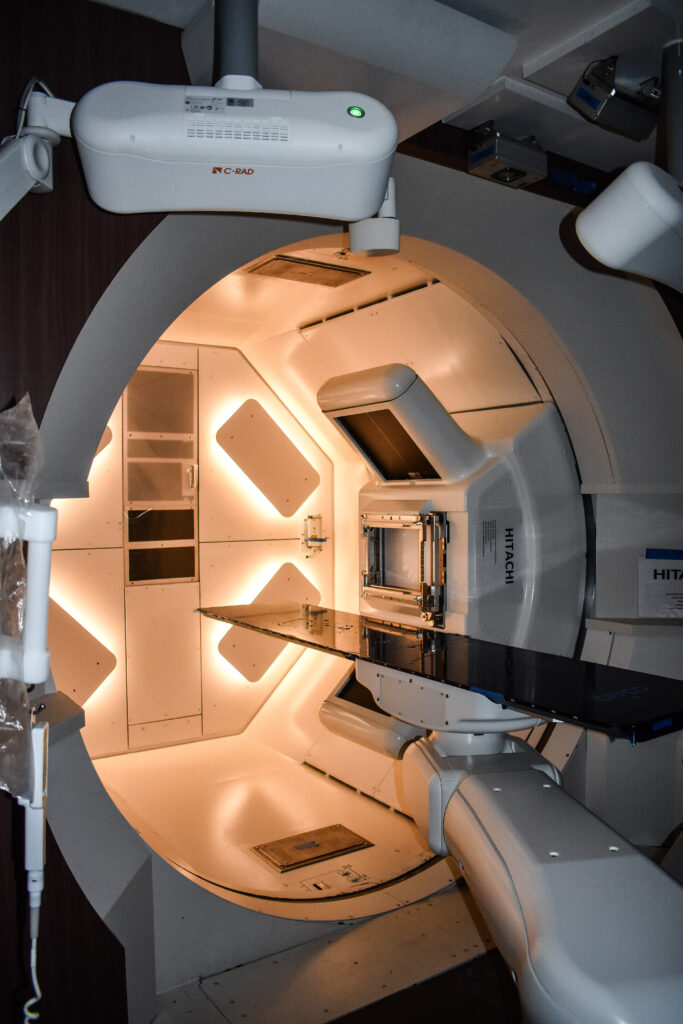
After years of planning, design, and construction, the UW Health Proton Therapy Program is preparing to welcome its first patients in 2026—marking a transformative step forward in cancer care for Wisconsin and beyond.
Located at the Eastpark Medical Center, the new Proton Therapy Center represents a major milestone for the Department of Human Oncology. This highly specialized treatment uses precise proton beams to target tumors while minimizing radiation exposure to healthy tissue—a breakthrough particularly important for pediatric patients and those with cancers near critical organs.
From First Beam to First Patient
The “first beam,” achieved earlier this year, was a key milestone indicating that the proton therapy technology is fully installed and operational. The next phase is focused on rigorous testing, calibration, and clinical readiness. “Spring 2026 is our go-live target for the gantry treatment room,” said Dr. Benjamin Durkee, Medical Director of Proton Therapy. “That’s when we expect to treat our first patient. The fixed-beam room will follow a few months later.”
Each milestone represents a complex and rewarding partnership between UW Health, the University of Wisconsin–Madison, and international engineering teams.
“The handoff from Hitachi to UW Health marks the transition from construction to operation,” Durkee explained. “We’re now ensuring every system meets the highest safety and performance standards.”
Expanding the Team and Capabilities
To support the new program, UW Health has added 14 specialized positions, including radiation therapists, medical dosimetrists, and a child life specialist to assist pediatric patients through treatment. The center will treat both adult and pediatric patients, with the pediatric program led by Dr. Brett Morris.
“From the start, we wanted to make sure our youngest patients have a supportive, family-centered experience,” Durkee said. “The addition of a child life coordinator is a big part of that.”
What Makes UW’s System Unique
While proton therapy is becoming more widely available, UW Health’s system stands out for its precision and technology integration. It features real-time surface guidance, motion management, and full onboard 3D imaging—including diagnostic-level imaging on the upright system.
One of the center’s most remarkable features is its true pencil-beam scanning capability. “A number of centers have pencil-beam scanning, but in many cases the beam is closer in size to a paintbrush,” Durkee explained. “Ours truly is the size of a pencil—allowing us to sculpt radiation around tumors with extraordinary accuracy. That’s the same level of technology used at all top institutions.”
Looking Ahead
As UW Health’s proton therapy program moves from concept to clinic, it will significantly expand treatment options for patients across the Midwest. “This is where all the planning pays off,” said Durkee. “We’ve built something truly state-of-the-art that will make a difference in people’s lives.”
Stay tuned for updates as UW Health approaches its first patient treatment in 2026—a moment years in the making and one that reaffirms the institution’s commitment to advancing cancer care through precision, compassion, and innovation.