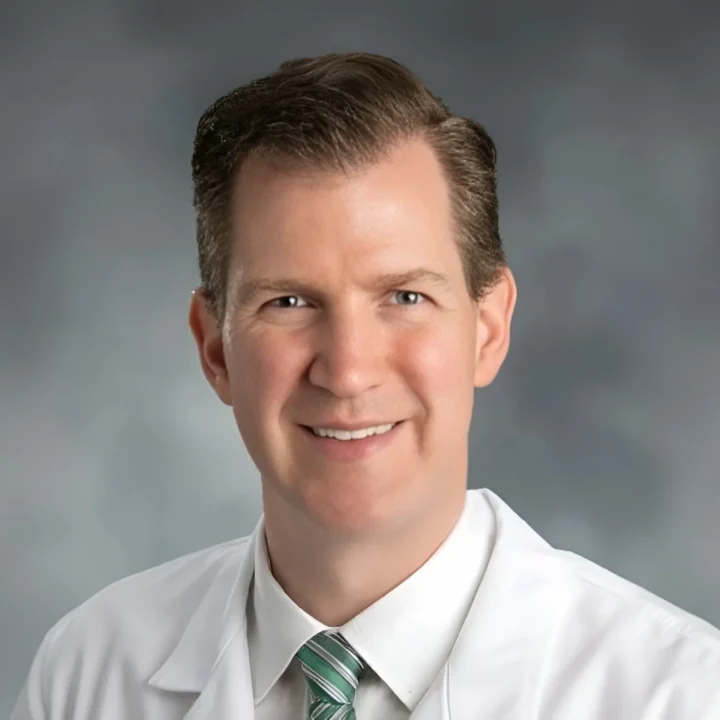
 Dr. Christian Hyde, MD, joins UW–Madison as an incoming assistant professor with deep expertise in proton therapy and a forward‑looking vision for the future of radiation medicine. Trained at one of the nation’s earliest proton centers and internationally engaged in cutting‑edge research, Dr. Hyde brings hands‑on experience with innovative technologies including proton arc therapy, upright treatment systems, and novel radiation techniques. In this Q&A, he shares what drew him to proton therapy, what excites him about teaching and discovery, and why this moment is transformative for patient care.
Proton Therapy: How did you choose that specialty and decide to pursue a fellowship in that area?
In 2018, I had an unexpected opportunity to either pursue a dedicated fellowship year of proton training, or to start working at a proton center and take a one-week course. Many physicians learn new skills in a short course or pick it up gradually on the job, but I wanted a really deep understanding of how protons work, who is a good candidate and more importantly why, and what are some of the current limitations and future possibilities.
Luckily, William Beaumont Hospital in the Detroit area had just opened the year before and patented a new approach: Proton Arc therapy, where the beam rotates continuously around the patient, offering great flexibility in avoiding normal tissues. I wanted in, so my family and I moved there for what we thought would be a one-year training experience that led to five more years at the new McLaren Proton Therapy Center in Flint, MI.
It was one of the most humbling experiences of my life, going back as a trainee after being an attending doctor for 12 years and founding a new department in Atlanta, but it was worth it to get hands-on training from true experts in the field.
Was there a defining moment?
The defining moment actually came to me about six months before deciding on the fellowship. One of my co-workers, a dosimetrist named Shannon Kinser in Atlanta, asked me what type of radiation therapy I would want if I ever had cancer myself. I told her: “MRI-Guided Arc Proton Therapy.”
She said, “Wow, that sounds great. Where can I get that?” I let her know that it didn’t exist yet, but it seemed plausible because we had MRI guidance, we had arc X-rays, and we had proton therapy, so we only needed to combine all three in a single setup. Now in 2026, people are making it a reality, but you still can’t buy one yet.
What is it about the technology that you are passionate about?
New beams. We can’t keep doing the same old thing and expect better results, so to me, that means we need new beams, or new ways of using the old ones. Protons are a new beam, and so is FLASH radiation—an intense beam that only lasts a microsecond—and so are mini-beams: millimeter-wide beams that “shred” the tumor in strips rather than “bake” the whole tumor in a uniform dose of radiation.
We’ve never had instantaneous nor truly scalpel-like beams in radiation therapy before, so FLASH and mini-beams could open up entirely new types of treatment.
What attracted you to the University of Wisconsin–Madison and our proton therapy center?
At first it was the technology, and now it is the people. I had reached out to Dr. Ben Durkee, the proton medical director, and Carri Glide-Hurst, UW Health’s chief medical physicist, to propose joint research using the upright chair system.
It turns out Ben and Carri are awesome people, thoughtful and kind, in addition to being super smart and leaders in their field. They’ve been really welcoming and helped me feel at home.
Since beginning, how have you been spending your time?
We have great physicists who came here from world-renowned proton centers like UPENN and New York Protons, using state-of-the-art equipment to commission what will be the most advanced proton center of its kind—able to treat patients lying down and also upright in the Leo Cancer Care system.
Not everyone can lie down flat long enough to get proton treatment. The lungs are more open upright, and the liver doesn’t shift as much. We still need to find out who is the best candidate for upright and why, so I’m involved in research to help answer those questions.
In your new role at UW, is there an aspect you’re particularly passionate about?
I gave a lecture online about a recently re-discovered type of GRID radiation, and at the end, I felt like it had been the highlight of my whole year. It brought tremendous joy to my soul to be able to share something that I’m really passionate about.
Some of the residents I taught picked up the baton and are starting a clinical trial using a similar technique.
What are you looking forward to accomplishing in your first year here?
I like the Department name’s pivot to “Radiation Medicine,” which means using energy sources like protons and X-rays for more than just cancer. We now have good science showing that low-dose X-rays can change the nature of chronic inflammation and reduce the need for invasive procedures.
In short, there has never been a better time to be in radiation medicine. We’ve never been more accurate, less harmful, or more curative for more diseases than we are now.